If you run a technology-driven company, you have probably heard statements like these in strategy discussions:
“Our market is energy.”
“Our market is manufacturing.”
On the surface, those statements sound reasonable. But they usually hide a deeper problem.
Energy and manufacturing are not markets. They are industries.
And confusing the two is one of the most common strategic mistakes I’ve seen while working in green energy technology and later in enterprise software.
The difference matters more than many CEOs realize. Because Industries are defined by technologies. But Markets are defined by customer challenges.
Understanding that distinction is where strategy should start. And in my view, this is also where marketing should start. Not with campaigns. Not with messaging. But with understanding.
In that sense, marketing is Step 0.
A simple framework CEOs can use
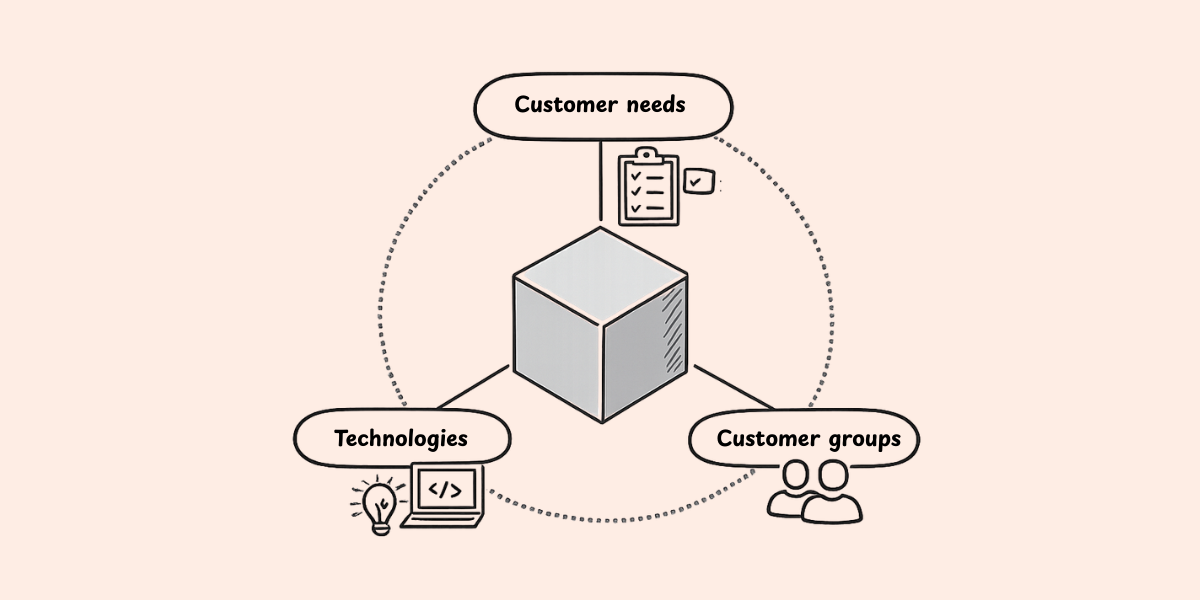
A useful way to think about market definition comes from strategy scholar Derek Abell. He suggested that a market can be understood through three dimensions:
- Customer groups – who you serve
- Customer needs or challenges – what problem they are trying to solve
- Technologies – how that problem can be solved
Industries typically focus on technology. Markets focus on customers and their problems.
In other words:
Industry = technology view
Market = customer challenge view
Let me illustrate this with examples from industries I’ve worked in.
Example 1: Green energy technology
Many companies in renewable energy describe their market simply as: “The energy sector.”
But that does not really define a market.
What actually defines the market are the specific challenges energy companies are facing.
In Europe, one of the biggest priorities in recent years has been reducing dependence on Russian gas while accelerating renewable energy deployment.
This shift has created new operational challenges such as:
- integrating large amounts of renewable energy into power grids
- maintaining grid stability as intermittent energy sources increase
- forecasting renewable energy production more accurately
- improving energy system resilience
If you apply the Abell framework, the picture becomes much clearer.
-
Customer group: European grid operators and utilities
-
Customer challenge: Managing grid stability while integrating renewable energy
-
Technology: Forecasting software, grid analytics platforms, energy optimization systems
Now the market becomes clear. It is not simply “energy”. It is something much more specific:
Utilities managing grid stability in a renewable-heavy energy system.
Technology companies that understand this challenge position themselves much more effectively than companies that simply say they “serve the energy industry.”
Example 2: enterprise software in manufacturing
The same issue appears in enterprise software. I once worked with a company that described its market simply as: “Our market is manufacturing.”
But manufacturing is not one market. It includes very different industries such as:
- automotive manufacturing
- electronics production
- pharmaceuticals
- industrial equipment
Each of these sectors faces different operational challenges. For example:
A pharmaceutical manufacturer operates under strict regulatory compliance requirements.
An automotive supplier, on the other hand, often struggles with complex global supply chains and production coordination.
Applying the Abell framework again helps clarify the market.
-
Customer group: Automotive suppliers
-
Customer challenge: Managing increasingly complex global supply chains
-
Technology: Enterprise software for supply chain visibility and production planning
Now the market is much more precise. Instead of “manufacturing”, the company serves:
Automotive suppliers dealing with complex supply chain coordination.
That clarity makes positioning, sales focus, and product development much easier.
Why this matters for CEOs
Market definition is not a light exercise. It affects almost every strategic decision in your company:
- where sales teams focus
- which product capabilities matter most
- how your company positions itself
- which customers you prioritize
- and how you eventually grow the company, from the inside out.
Yet in many organizations, marketing only enters the conversation after these decisions are already made.
After the product roadmap is defined. After the strategy is approved. After the market focus is decided.
At that point, marketing is expected to “communicate” the strategy. But the most valuable contribution marketing can make happens before that stage. Because understanding the market means understanding:
- which customer groups feel the problem most strongly
- which challenges create urgency
- which technologies solve those challenges best
And that understanding should shape the strategy itself.
That is why I often describe marketing as Step 0.
Not promotion. But understanding.
Because when leadership teams clearly understand the market they operate in, many strategic decisions suddenly become much easier.
And in complex technology sectors, that clarity often determines whether a company simply builds interesting technology, or builds a successful business.