I’ve worked in both industrial engineering environments and software companies, and one pattern shows up repeatedly. Most industrial tech companies do not struggle because their technology is weak. They struggle because the path from technology to market is unclear, almost like trying to navigate a city without street names. Everything exists, but nothing is structured in a way that helps you move forward.
Software companies build structure before they build scale
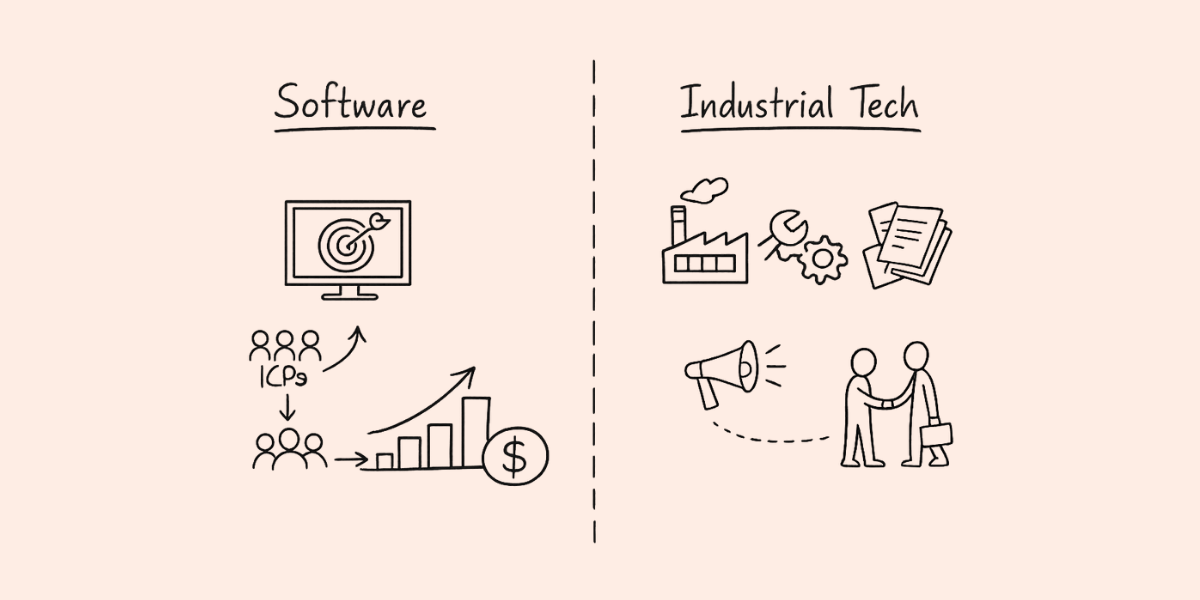
In software companies, especially those building complex B2B platforms, there is usually a deliberate commercial structure that connects product development to market execution.
They define who they are building for, how those customers behave, what problems matter in their daily operations, and how value is perceived in decision making. That structure removes guesswork and replaces it with direction.
And importantly, software companies measure their growth in a very explicit way: Annual Recurring Revenue, ARR.
ARR is not just a financial metric. It is a reflection of how clearly a company understands its market, its customers, and its ability to consistently generate value over time.
Even when the business is not perfectly subscription based, the logic still applies. Revenue is mapped, tracked, and understood in a structured way, because growth without visibility is just noise.
Industrial companies often start with technology and add market definition later
In industrial tech, I often see a different starting point.
The technology is strong. Sometimes extremely advanced. Whether it is low temperature heat systems, steam boilers, cranes, or even gears, the engineering depth is rarely the problem.
The challenge is that commercial structure comes later, if at all.
Markets are described broadly as utilities, pulp and paper, oil and gas transition projects, steel production, wind industry, or district heating operators. These labels are true, but too wide to guide precise commercial action.
It becomes like trying to aim a lighthouse across an entire coastline and expecting it to highlight a single harbour entrance. Everything is illuminated, but nothing is prioritised. Add to this the fact that typically, sales isn't an equipped army, but typically a handful of technical sales guys and rarely girls, who work more as problem-solvers on demand than as a focused commercial engine.
(If you're new on my blog: I typically work with SMEs, where this pattern holds even more clearly than in larger organisations; although the underlying principle applies in both.)
Marketing becomes visibility instead of a system
What often follows is a predictable setup.
Marketing becomes brochures, technical datasheets, and product leaflets. Presence at events like HeatExpo or WindEurope becomes the main visibility channel to name a few.
These events are extremely valuable. They are where relationships are built and projects are discussed. But in many companies they become the backbone of commercial activity rather than a part of it.
At the same time, LinkedIn activity is often inconsistent. A project announcement here, a technology update there, sometimes a recruitment post, but rarely a coherent narrative that connects market, value, and customer journey.
And most importantly, marketing and sales often operate as parallel functions instead of one integrated system.
Marketing builds awareness. Sales builds relationships. But the bridge between them is often assumed rather than designed.
Software companies think in systems, not silos
Software companies tend to structure this differently.
Even in complex enterprise environments with long sales cycles, there is usually a deliberate system behind growth.
They define ICPs (ideal customer profiles). They build personas for decision makers and users. They segment based on behaviour, urgency, and use case. They translate technical capabilities into clear business value. And they build a narrative that runs consistently across all touchpoints.
From first awareness to deal closure, the system is designed to reduce uncertainty.
Growth does not stop at the first deal
Another important difference is how growth is understood after deals are closed.
Software companies do not only focus on winning customers. They focus heavily on expanding them.
A customer might start with one module, one department, or one workflow. Over time, they expand into additional modules, teams, or geographies.
This is often described as Land and Expand, and it creates a structure where growth is not dependent on constant new acquisition alone.
Industrial revenue exists, but it is often not mapped as a system
Industrial companies often underestimate how structured their revenue actually is.
When I work with companies in this space, I rarely start with “projects”. Instead, I ask them to map their last 10 deals in detail.
Not just large EPC contracts or turnkey installations, but everything that generated revenue.
That includes:
- Engineering hours attached to feasibility studies
- Small retrofit projects for existing assets
- Service agreements for maintenance or optimisation
- Add on control system upgrades
- Commissioning support and follow up work
- Spare parts or operational adjustments after delivery
When you do this properly, something interesting happens.
Revenue is no longer just a list of projects. It becomes a pattern of how value is actually created over time.
And in many cases, companies realise that a significant part of their business is hidden inside what they previously considered “small work”.
Visibility creates alignment and alignment drives performance
This is where clarity becomes powerful.
When real revenue streams are visible, patterns emerge. Not theoretical segments, but actual buying behaviour. Real triggers. Real decision moments. Real moments where value was recognised and paid for.
And that creates alignment.
Alignment between sales and marketing. Alignment between leadership and execution. Alignment between what the company thinks it sells and what the market actually buys.
And in commercial organisations, alignment is often the difference between activity and performance.
The missing link is not capability but structure
Industrial companies already operate in highly complex environments. They design, build, and deliver systems that require deep technical expertise and coordination across multiple disciplines.
So capability is not the issue.
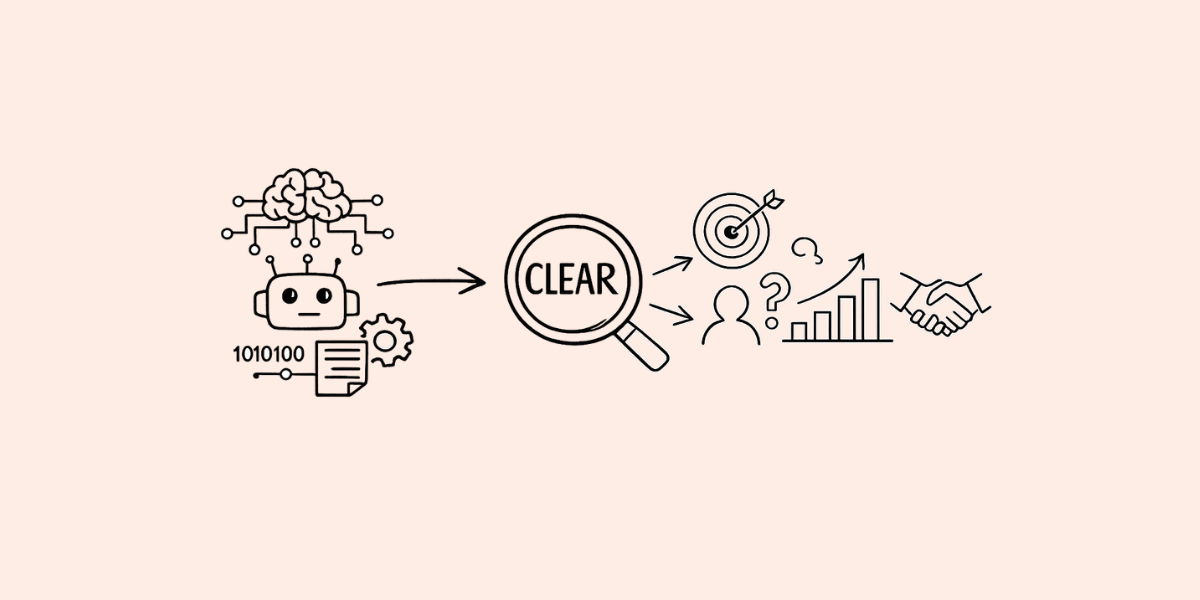
The missing piece is the structure that connects what they build to how the market actually buys.
Without that structure, even strong technology struggles to translate into predictable commercial outcomes.
What changes when you apply software thinking
When structured market thinking is introduced into industrial companies, the shift is often immediate.
Sales conversations become more focused. Marketing becomes more consistent. Value becomes easier to understand outside engineering teams. And lead generation becomes anchored in real buying situations rather than broad industry assumptions.
Most importantly, companies stop thinking in industries and start thinking in buying contexts and decision moments.
That is where demand becomes visible.
A simple way to start
I work with a Market Clarity Assessment designed to surface exactly these gaps.
It helps companies understand how clearly their market is defined, how well they translate technical value into commercial language, how structured their sales and marketing system is, and where deals tend to slow down.
It only takes a few minutes to complete, but it often reveals patterns that are not visible internally.
Take the market clarity assessment
If you work in an energy tech or industrial engineering company and want to understand how clear your commercial setup really is, you can book a short Market Clarity session with me.
In this conversation, we look at how your market is currently defined, how your value is communicated, and how your commercial setup is actually working in practice.
It is not a presentation. It is a structured diagnostic based on your real commercial reality.
You will walk away with clarity on:
- where your market definition is too broad or unclear
- how your value is currently translated in sales and marketing
- where your commercial system creates friction or inconsistency
- and what is holding back predictable growth
Learn more about the Market Clarity Service here →