(or: why most commercial pipelines in engineering companies break early)
I keep seeing the same pattern.
A company has built a solid product:
- the thermodynamics are right
- the performance is proven
- the engineers know exactly what they’re doing
Then I ask:
“What market are you targeting?”
And the answer is:
“Industry.”
“Companies that need heat.”
“District heating.”
Now let's pause for a second. 'Cause hthis is the part where I need to repeat myself again and again:
That’s not a market.
That’s a universe.
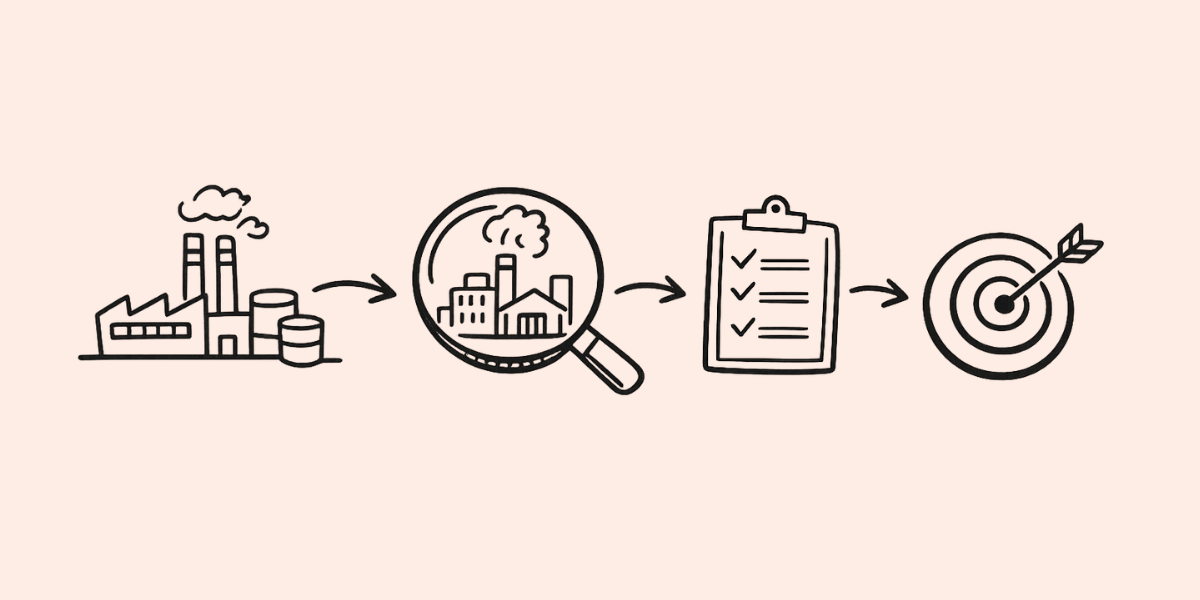
And once you start from a universe, everything downstream gets messy.
Where things start to break
A few months later, it usually looks like this:
- Sales has a lot of “interesting” conversations
- Marketing is active but not really pulling the right people in
- Pipeline looks full… but nothing is closing predictably
And internally, you hear:
“It depends…”
“Every project is different…”
That’s often true technically.
But commercially, it’s usually a sign that the market was never defined properly.
The uncomfortable truth
In engineering, you would never design a system without knowing:
- temperature levels
- load profile
- energy source
- constraints
You wouldn’t even start.
But commercially, many companies do exactly that.
They go to market first… and define the conditions later, inside the sales process.
That’s expensive.
What a “market” actually is
Let’s make it simple. Let's see what it isn't.
A market is not:
“who could use this”
A market is:
the set of conditions where your solution works — and will be bought
Two parts:
- it works
- someone is actually going to act
If one of those is missing, it’s not a market.
How I usually see it play out
I once had a dialogue with a CEO of a company selling heat solutions.
They said:
“We target food & beverage.”
Sounds reasonable.
But when we looked at their actual projects, a pattern showed up:
- only plants with continuous processes
- only where steam demand was stable
- only where energy costs were already a problem
- and almost always when a boiler was close to replacement
Everything else?
Early conversations. No decisions.
So “food & beverage” wasn’t the market.
A more useful way to define your market
(think like an engineer and define the operating window)
Instead of starting with industries, start with conditions.
Here’s a checklist I use in practice.
1. Physics (non-negotiable)
If this doesn’t fit, nothing else matters.
Ask:
- What temperature range do we serve?
- What energy source is required?
- What load profile do we need?
Example – electric boiler
- Steam up to ~200°C
- Needs sufficient electrical capacity
- Works best with stable demand
If a site doesn’t have grid capacity → stop.
No amount of marketing will fix that.
Example – industrial heat pump
- Typically below ~140–160°C
- Needs a heat source (waste heat, ambient, etc.)
- Needs high utilization
No source? No project.
Already here, you’ve removed a big part of the “market”.
Good. That’s the point.
2. Process (where does it actually fit?)
Now translate that into real operations.
Ask:
- Where in the plant is this used?
- Is it core production or support?
Not:
“food industry”
But:
“continuous steam-based processes like pasteurization or drying”
Now it becomes concrete.
3. System context (how does it plug in?)
Your solution never stands alone.
Ask:
- Is this base load, peak, or backup?
- Is it connected to district heating?
- Is it part of a hybrid system?
Example – electric boiler
I’ve seen it work best as:
- peak load in district heating
- backup in industrial steam systems
- or full replacement when timing is right
Same product. Different markets.
4. Buyer (who actually cares?)
Not who uses it. Who feels the pain.
Ask:
- Who owns the problem?
- Who signs off?
Usually:
- plant manager
- energy manager
- utilities manager
If you can’t point to a clear owner, expect slow movement.
5. Trigger (why now?)
This is the one most teams underestimate. Even if everything fits, nothing happens without a trigger.
Typical ones I keep seeing:
- Boiler is 20–30 years old
- Energy prices suddenly hurt
- CO₂ costs become visible
- Grid capacity becomes available
- Plant is being upgraded anyway
No trigger?
Then it’s a “nice idea”. Not a project.
Put it together: what a real market looks like
Weak version
“Companies looking to decarbonize”
Real version
Steam-based production sites
with stable demand
existing boiler setup
access to electrical capacity
and a boiler approaching replacement
Now we’re talking.
That’s something you can actually build a pipeline around.
What happens when you get this right
This is where things start to feel different internally.
Marketing stops guessing
Instead of broad messages, you can say:
“If your boiler is reaching end of life and you have grid capacity, this is worth a look.”
That lands.
Because it reflects a real situation.
Sales stops chasing everything
You get faster conversations like:
“This fits, let’s move forward”
or
“This won’t work, let’s not spend time on it”
Both are valuable.
Pipeline becomes more predictable
When projects come from similar conditions:
- timelines align
- decisions follow similar logic
- forecasting becomes less of a guessing game
This is what I mean by engineering growth
You already think in systems when you build your product. The shift is to do the same commercially.
Not more campaigns. Not a new CRM.
But starting with:
- constraints
- operating conditions
- where it works
- where it doesn’t
A simple test
Ask your team:
“Can we describe our market like a system specification?”
If the answer is vague, you don’t have a defined market yet.
It should sound like this:
- temperature range
- energy source
- load profile
- system role
- buyer
- trigger
If one is missing, expect friction later.
One last thought for the road
I’ve yet to see a company struggle with growth because they didn’t run enough campaigns.
I’ve seen many struggle because they started from a universe instead of a defined system.
Define the system first.
Then build everything else on top.